
Most vulnerability scanners work the way you would expect: they send a request, read the reply, and look for something suspicious in it. An error message, a stack trace, a reflected script tag, a status code that should not be there.
That works well, right up until the vulnerability does not change the reply at all.
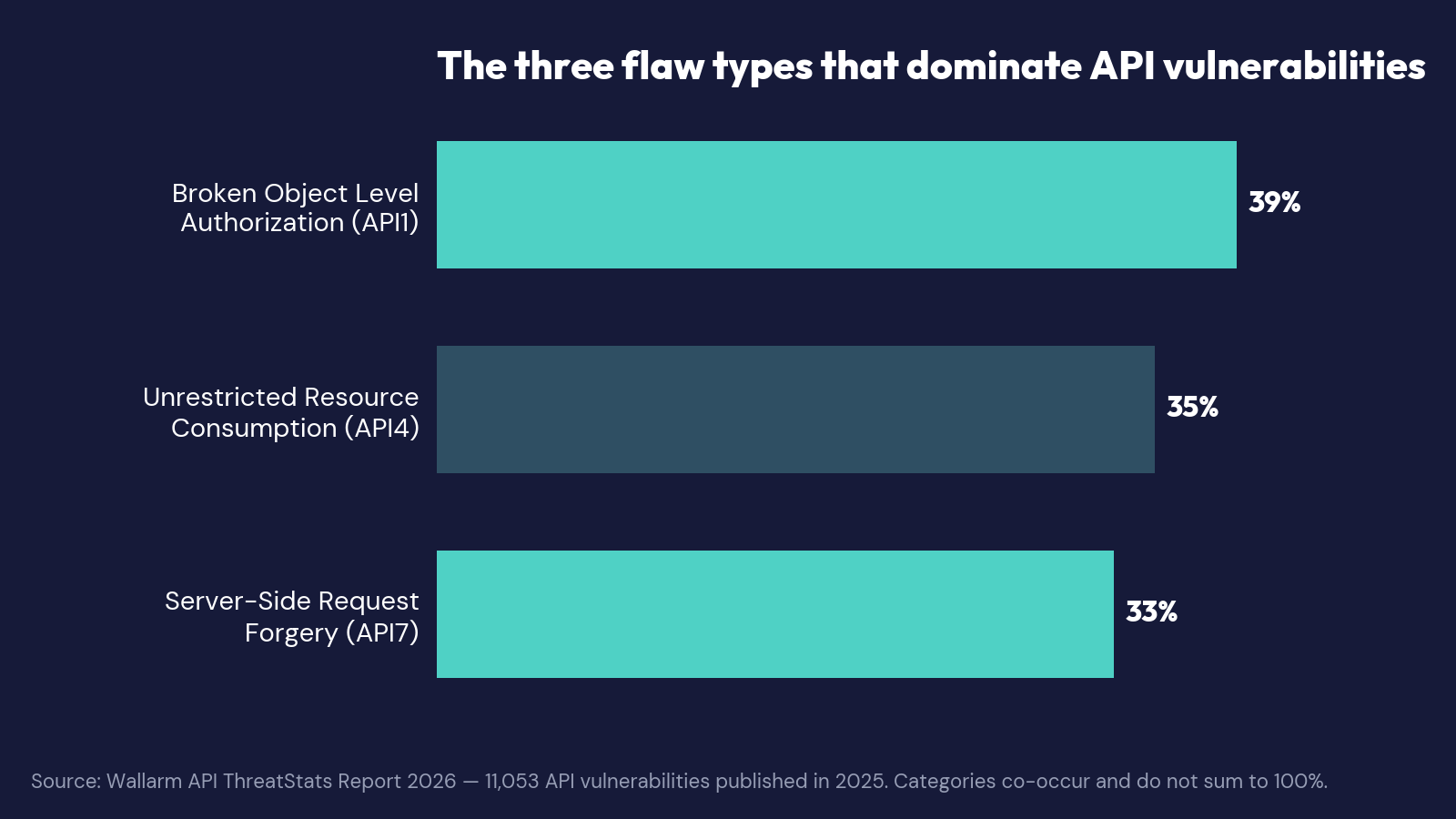
There are two large families of serious flaw where the response comes back looking completely, boringly normal — and where a scanner built around reading replies therefore reports nothing. They are not edge cases. Going by the published figures for 2025, each of them on its own ranks among the three most common types of API vulnerability found all year.
Family one: the flaw that happens somewhere else
Picture an endpoint that accepts a web address. Plenty do — an avatar importer, a "fetch this invoice from our supplier", a webhook tester, a PDF generator that pulls in a logo, a link preview.
You give it an address. The server quietly goes and fetches it. Then it returns the same cheerful 200 OK it always returns, because from the application's point of view nothing went wrong.
Something did go wrong. Your server just made a request to an address a stranger chose. Point it at an internal admin panel, a cloud metadata service that hands out credentials, a database that is firewalled from the outside world but wide open from the inside, and the server fetches that too. The reply to the attacker is empty, or generic, or identical to the one everybody else gets. The damage is entirely invisible from the outside.
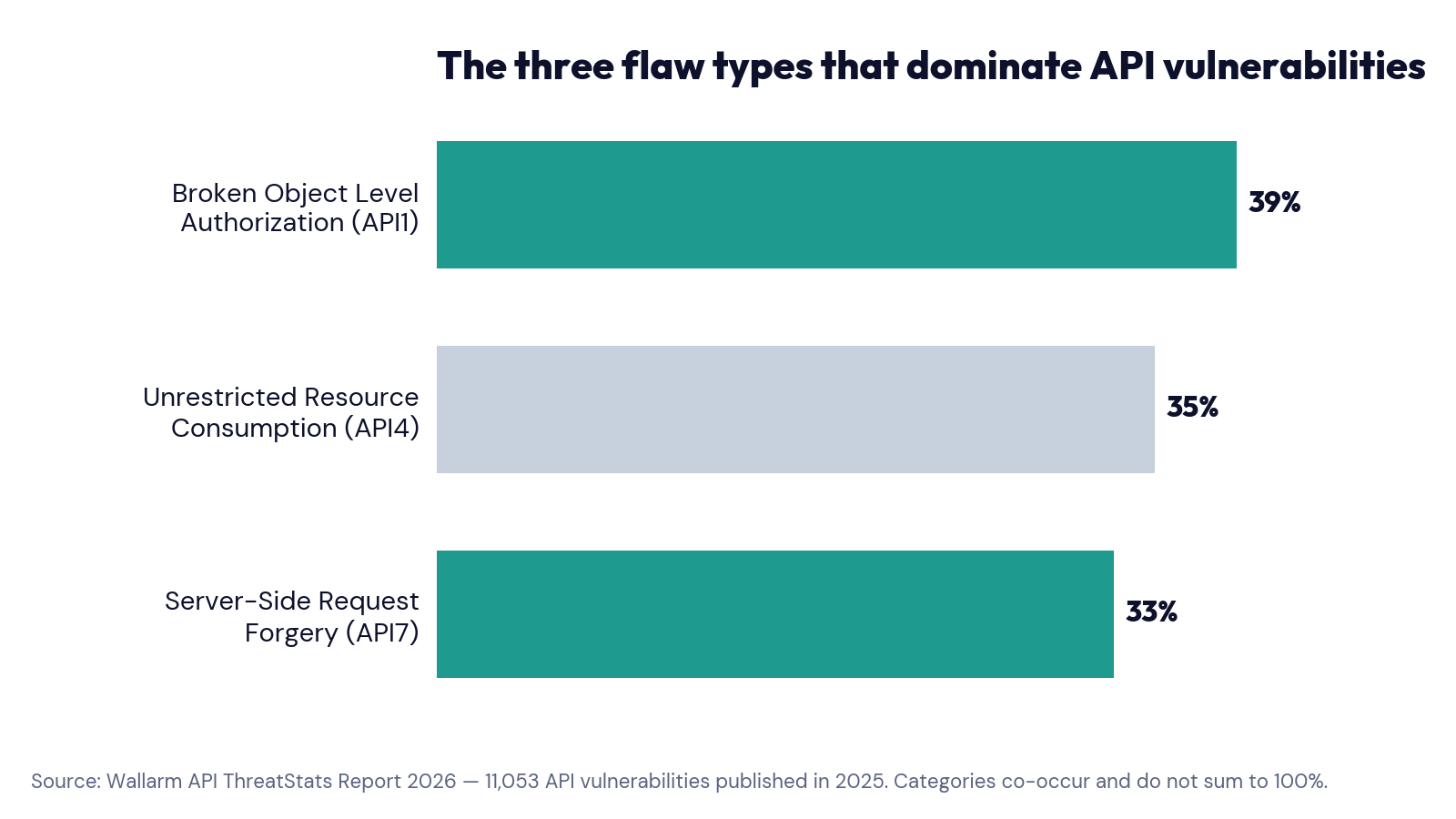
This class is called Server-Side Request Forgery, and it was present in 33% of the API vulnerabilities published in 2025. The same shape shows up elsewhere: a command that runs but prints nothing, a database query that executes but returns the same page either way, a script that fires in an administrator's browser three days later when they open a support ticket. Security people call these blind or out-of-band flaws, because the proof never comes back through the front door.
How you catch something invisible
The trick is to stop waiting for an answer and start listening somewhere else.
Instead of asking the server a question and reading the reply, you give it an address you control — a one-off, randomly generated hostname that belongs to a listening server out on the internet. Then you wait. If anything ever contacts that address, the application did what you told it to. No reply needed. The contact itself is the proof, and because every test gets its own unique address, you know exactly which endpoint and which parameter caused it.
This technique is called out-of-band application security testing, or OAST. The listening server is the key piece: without one, these flaws are simply not findable by automation, which is why many scanners do not report them at all. It is also why the findings come with unusually little doubt attached. A scanner guessing from an error message can be wrong. A server that physically reached out and contacted a host it had no business contacting is not a guess.
Two practical notes. A callback can take minutes or days to arrive — the three-day-later admin browser case is real — so this kind of testing has to keep listening after the scan itself has finished. And the callback address has to be unique per test, or you get a result with no idea which request produced it.
ClickScan runs OAST-backed checks as part of its scanning, with its own callback infrastructure, and correlates each interaction back to the exact request that triggered it.
Family two: the response is correct, just not for you
The second family is sneakier, because here the application is working perfectly. It is simply working for the wrong person.
Say you are logged in and you open invoice number 1042. The address bar reads /api/invoices/1042. You change it to 1043 and press enter. If invoice 1043 belongs to a different customer and you can read it anyway, that is a broken authorization check. The API confirmed you were logged in. It never confirmed the record was yours.
That is Broken Object Level Authorization, usually shortened to BOLA. It was present in 39% of API vulnerabilities published in 2025 — the single largest category in the chart above. Its close relative, Broken Function Level Authorization or BFLA, is the same failure applied to actions rather than records: a normal user reaching an endpoint meant for administrators, or sending a DELETE where the interface only ever offered them a "view" button. The screen never showed them the option, so nobody checked whether the server would refuse it.
Now consider what a scanner sees when it tests invoice 1043. It sees a valid invoice. Correct JSON, sensible fields, 200 OK. There is no error to pattern-match, no anomaly, nothing malformed. The response is not suspicious in any way — it is a perfectly good invoice that happens to belong to somebody else.
This is why authorization flaws are structurally hard to automate, and why generic scanners tend to skip them. Catching one requires something a single-session scanner does not have: knowledge of who owns what. You need at least two separate logins, a record of what each of them is legitimately allowed to see, and then a comparison — fetch an object as its owner, fetch it again as the other account, and look at whether the second account got the same data. The flaw only becomes visible in the difference between two identities. One identity on its own can never reveal it.
ClickScan tests for BOLA and BFLA using exactly that multi-identity approach, which is the part most automated scanning leaves on the table.
Why the time pressure is real
The other thing the 2025 data makes clear is how little room there is between "a flaw exists" and "a flaw is being used".
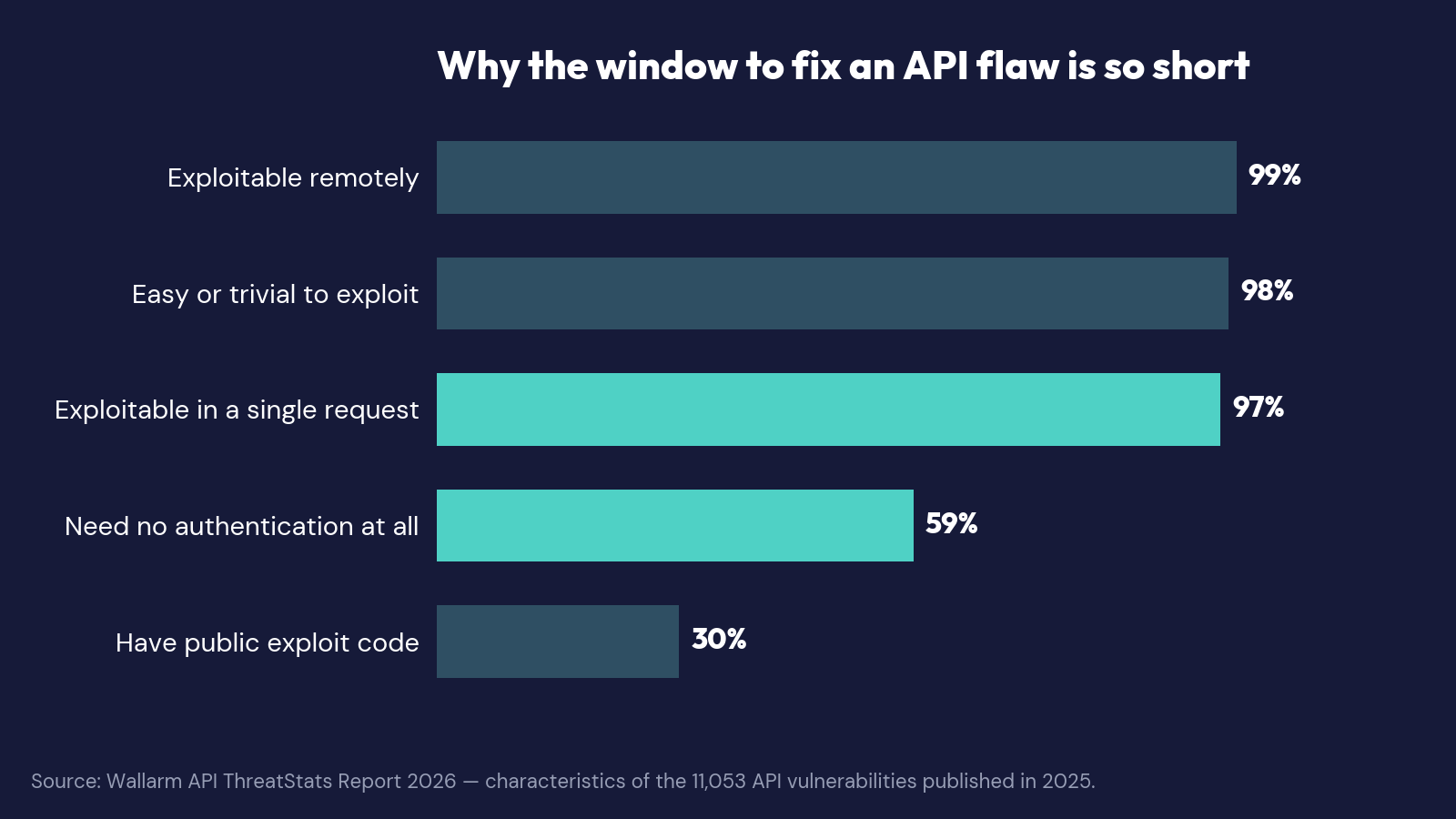
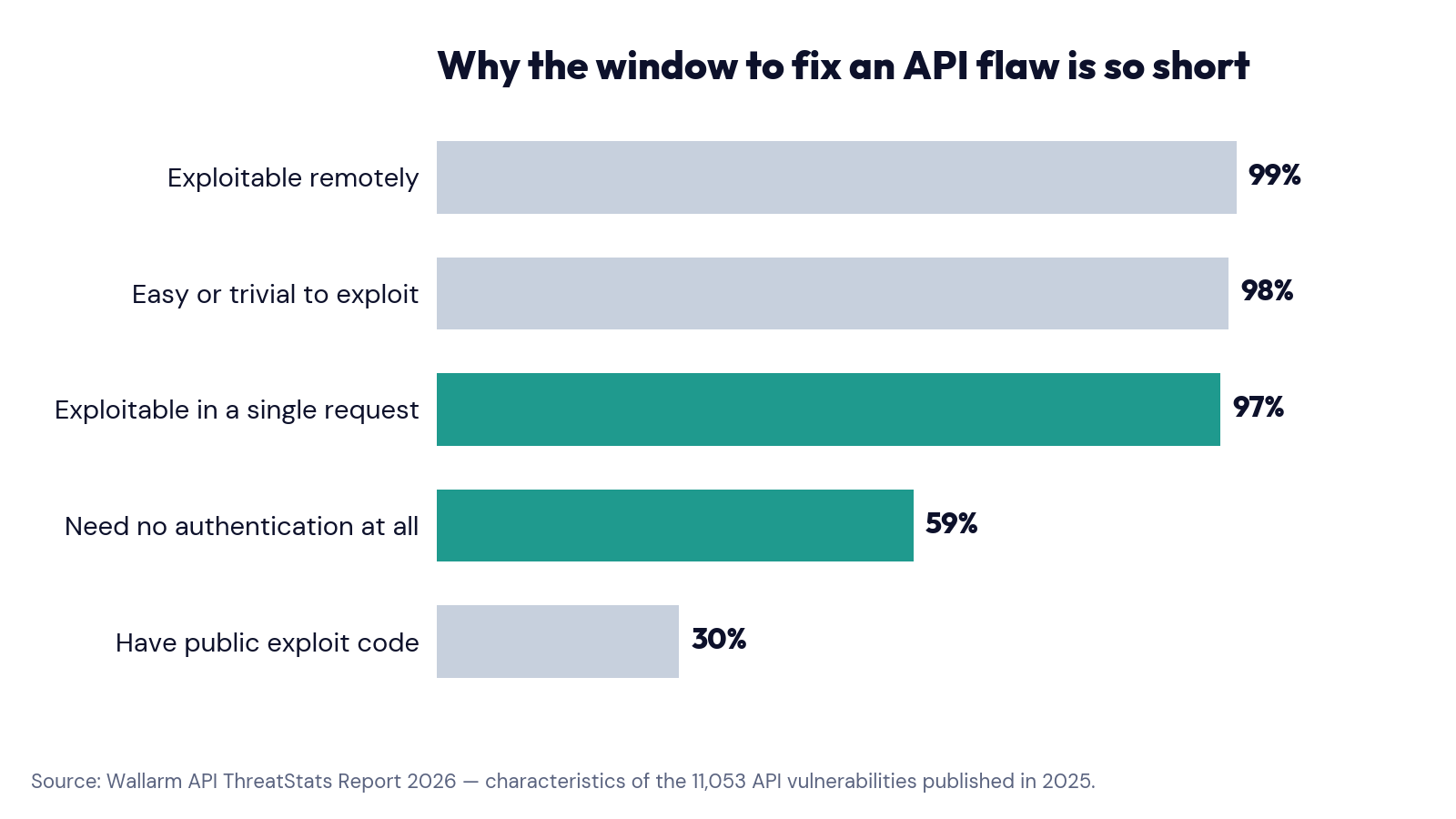
Three numbers there matter more than the rest. 97% can be exploited with one single request — there is no slow build-up to spot, no suspicious sequence, no second chance to notice. 59% need no login whatsoever, so "only our customers can reach it" is not the protection people assume. And 67% are rated high or critical severity, while only around 1% need any real skill to pull off. Scale, not sophistication, is what makes this dangerous.
Put the two charts together and the shape of the problem is clear enough. The flaws that dominate by volume are heavily weighted toward exactly the two families that reading responses cannot find, and they are quick and easy to exploit once someone goes looking.
What to actually do about it
You do not need a security team to make progress here. You need to know which questions your current testing is answering and which it is quietly skipping.
- Ask your scanner whether it does out-of-band testing. If there is no callback infrastructure behind it, blind flaws are outside what it can find, however long the report is. A clean report is not the same as a clean application.
- Ask whether it tests with more than one account. Single-session scanning cannot find authorization flaws, by construction. If nobody gave the tool a second login, BOLA and BFLA were never on the table.
- List the endpoints that accept a URL, a file path or a hostname. Avatar imports, webhooks, PDF and preview generators, "import from" features. That list is your out-of-band exposure, and it is usually shorter than people fear.
- List the endpoints that take an id. Anything with a number or a reference in the path is a BOLA candidate. Then test the boring way: log in as two different customers and try to read each other's records.
- Check the admin-only actions from a normal account. Not through the interface — the interface hides the button. Call the endpoint directly and see whether the server says no.
The last two you can do by hand this afternoon on your most important application, and it is worth doing even if you later automate it. Knowing that your own API refuses the request is a different kind of confidence than assuming it does.
If you would rather see what responds from the outside first, a ClickScan scan maps the surface, and what it checks sets out each check in plain language. For applications where the answer needs a person rather than a tool, there are expert services for that too.
Sources: Wallarm API ThreatStats Report 2026 · OWASP API Security Top 10 (2023)
All percentages come from Wallarm's analysis of 67,058 security bulletins published in 2025, of which 11,053 were API-related. The OWASP categories co-occur in the same vulnerability, so those figures do not sum to 100%. We have not independently verified Wallarm's dataset.