
For any name worth impersonating, thousands of variations resemble it. Almost all are unregistered, parked, or owned by somebody with no interest in you at all.
A tool that hands you nine hundred "threats" has told you nothing. The useful question is which of them can do something: receive email, which is what a phishing campaign needs, or serve a website that may be copying yours.
How the candidates are built
The monitor generates variations the way somebody trying to fool your customers would:
- Look-alike characters — the Cyrillic
аthat renders identically to a Latin one,rnreading asm,1forl. - Typos — a transposed pair, a doubled letter, a missing one, a key struck next to the right one.
- Compound names — your brand plus
-login,-support,-secure,-billing, the words that make a phishing link look like infrastructure. - Alternative endings — the same name under a different domain ending.
The deep sweep widens all of that: every country ending rather than the common ones, two look-alike substitutions at once, and every single-character typo.
How each candidate gets a verdict
Every generated name is checked in public DNS. The registered ones are classified: parked or for sale, another company's brand protection, your own defensive registration, serving a website, or able to receive email. For a live domain that can receive mail, the report also asks the public certificate logs when it first started serving HTTPS, and for the handful most worth looking at it reads one thing from the look-alike: its site icon, compared against yours.
The website and email ones are what you act on. A registered domain that resolves nowhere is a note. One with an MX record can now receive email, which is the step before it sends any.
The part most tools leave out
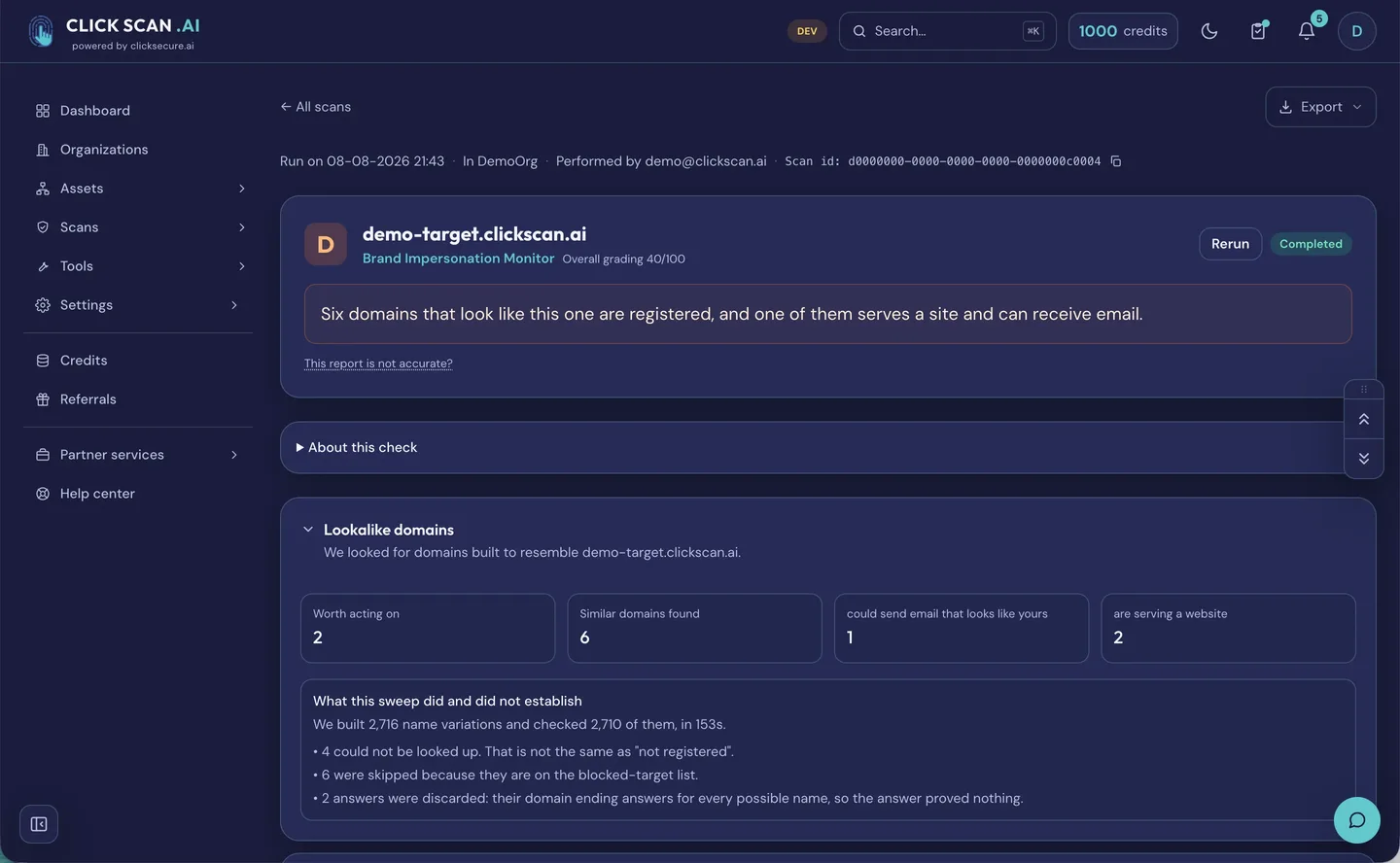
Look at the bottom of that report: 2,716 variations built, 2,710 checked, in 153 seconds — and then an explicit account of the difference. Some could not be looked up, which is not the same as "not registered". Some were skipped because they are on the blocked-target list. Some answers were discarded because the domain ending answers for every possible name, so the answer proved nothing.
Those six unchecked names are the difference between "nothing found" as a claim and as something you can verify. A coverage figure that silently rounds to 100% is the one number in a security report you should never trust.
Getting the findings out
The dangerous ones export as STIX 2.1 or YARA on a paid account, so they can feed a threat intelligence platform or a detection rule rather than living in a PDF — deliberately much less than the report shows, because an indicator lands in a blocklist with nobody in the loop.
What this is not
No takedowns, no trademark monitoring. Beyond public DNS and the certificate logs, the only thing ClickScan.AI reads from a look-alike is its site icon — no password is tried, no form is submitted. It establishes what exists and what it is capable of. Acting on it — registrar complaints, legal routes — is your call.
Neither the check nor the deep sweep needs proof of ownership. Start at app.clickscan.ai.