
A padlock in the address bar means one thing: the connection is encrypted. It does not mean the certificate is trusted by every client, that obsolete protocols are switched off, or that the server is not answering in ways it should have stopped answering a decade ago.
The TLS check needs no proof of ownership, because everything it reads is something the server publishes to anyone who connects.
The certificate itself
Expiry is the obvious one, and still the most common outage nobody planned for. Certificates now last months rather than years, and renewal is the sort of task that works until the person who set up the cron job leaves.
Beyond the date: the trust chain (does it actually terminate at a root the client trusts, or is an intermediate missing?), the key type and size and the signature algorithm — and, reported alongside but never graded, certificate transparency, whether the certificate was logged publicly, and CAA, the DNS record that tells certificate authorities which of them may issue for your name at all. Comparing who has actually issued for you against your CAA list is the Domain and DNS Security Check's job.
What the server will agree to
A certificate can be perfect while the server negotiates a connection nobody should accept.
The check records the highest TLS version offered, whether TLS 1.2 and 1.3 are available, and whether TLS 1.0, 1.1 and SSL 3.0 are still accepted. It looks at cipher suites and forward secrecy — whether traffic captured today stays unreadable if the server's key is stolen next year. It checks HSTS, which tells browsers never to try the unencrypted version again, and OCSP stapling, where the server presents its own proof of non-revocation instead of making the browser go ask.
Named weaknesses, probed rather than guessed
Heartbleed, POODLE, ROBOT, DROWN, Logjam, CRIME, Ticketbleed, CCS injection, insecure renegotiation, CBC padding oracles. Each is tested individually.
A weakness the probe confirms counts against the grade. Heartbleed, ROBOT, DROWN, Ticketbleed and anonymous ciphers are critical and grade F; the CBC padding oracle, CRIME and insecure renegotiation grade D; BEAST and client-initiated renegotiation grade C. One marked "not tested" never does.
That distinction matters more than it sounds. A tool can infer a weakness from a protocol version alone — and be wrong, because the server may not accept what the attack needs. ClickScan.AI probes each one on that list.
And when a check genuinely could not be run, the report says "not tested" rather than quietly leaving it out. A list showing only what was looked at reads as an all-clear, which is the most expensive kind of misleading.
What you get
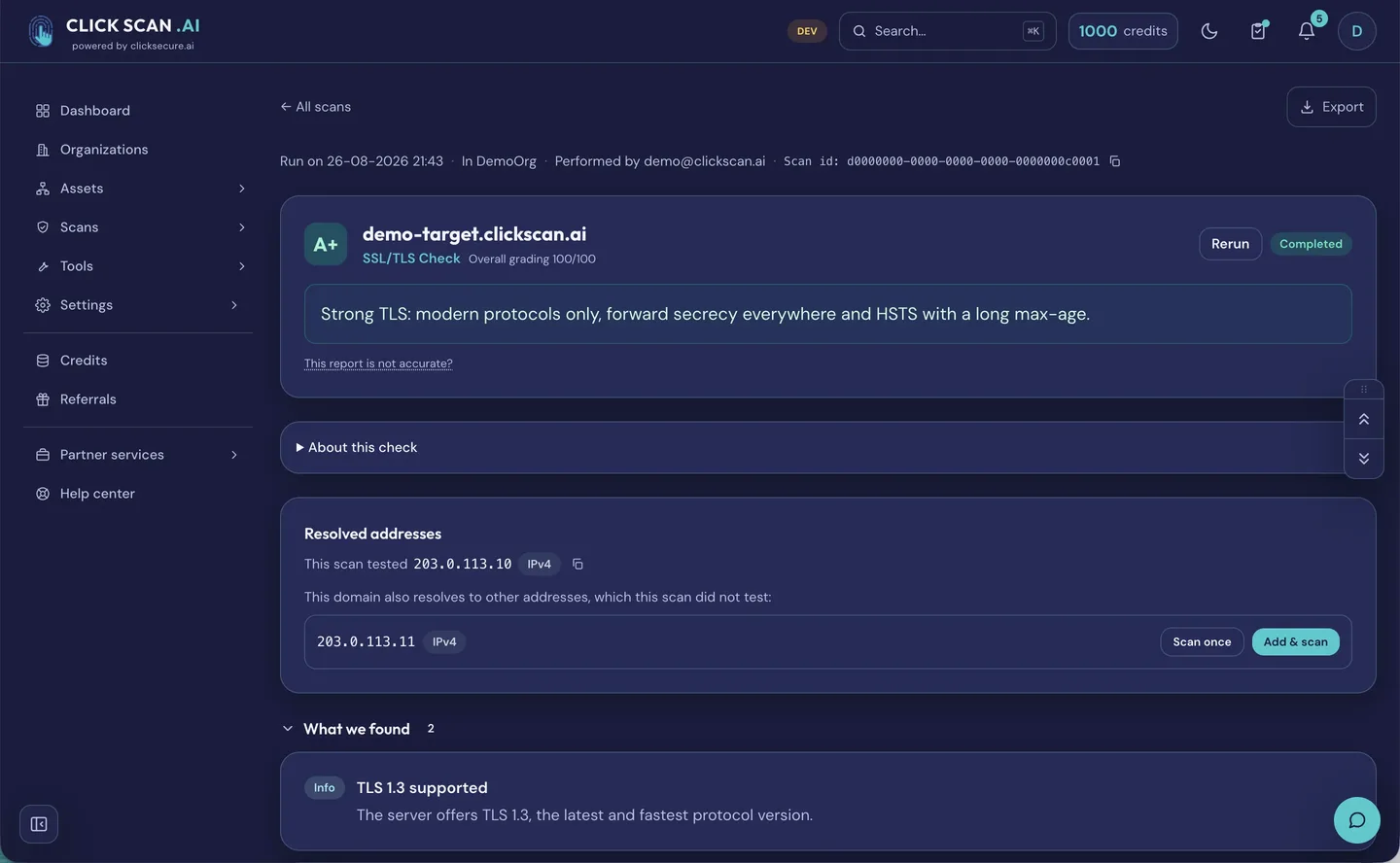
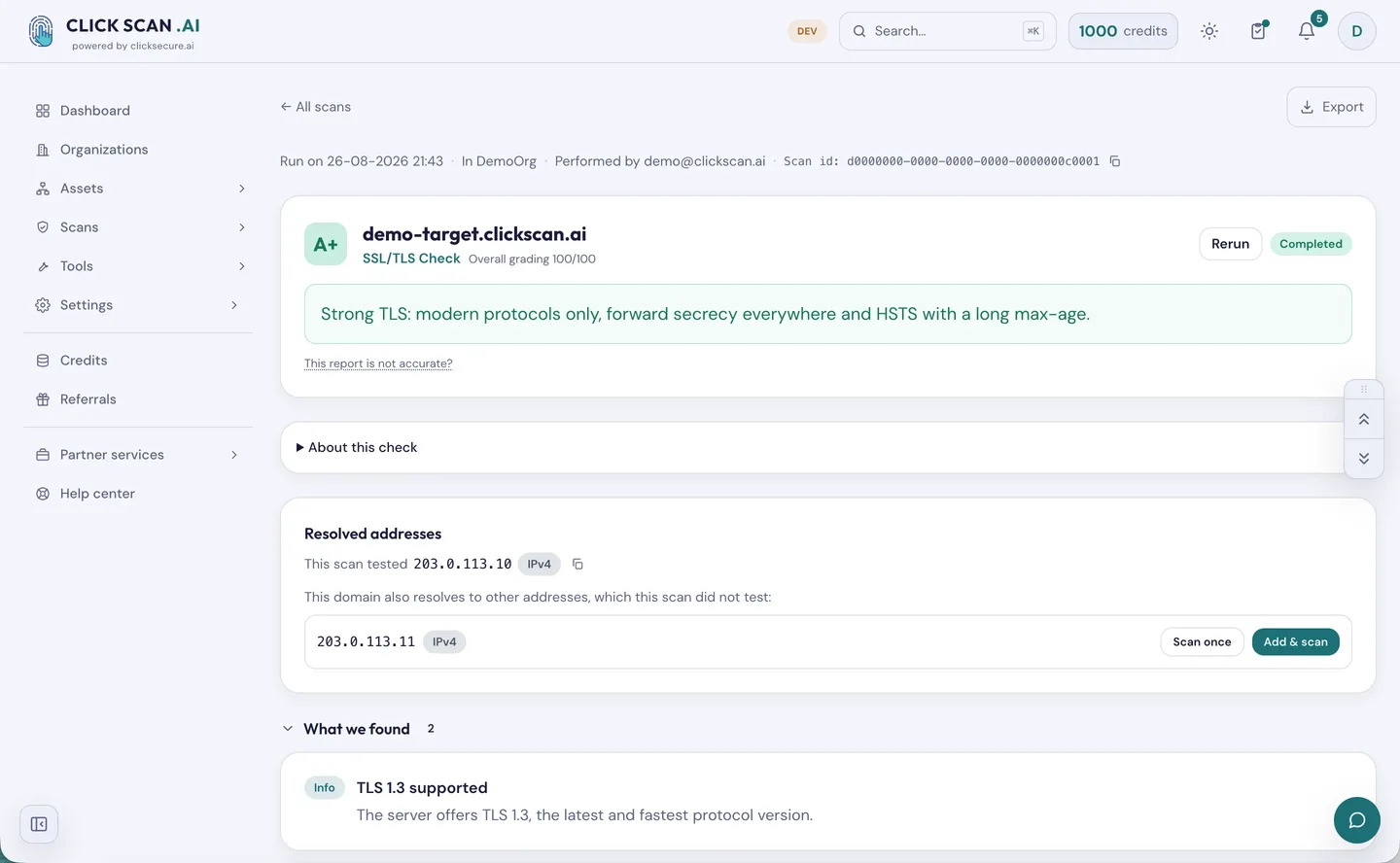
A grade from A+ to F, the finding that drove it, and what to change — and the date the certificate expires.
After that, expiry is watched for you. For every asset whose latest SSL/TLS check finished in the last 90 days, you are warned 30, 7 and 1 days before the certificate expires and again once it has — in the app each time, and by email at 7 days, at 1 day and on expiry. No schedule is needed; renew the certificate and run the check again, because the warnings follow the certificate the last check saw.
Run it free: every new account gets starter credits. Start at app.clickscan.ai, or see everything ClickScan.AI checks.