
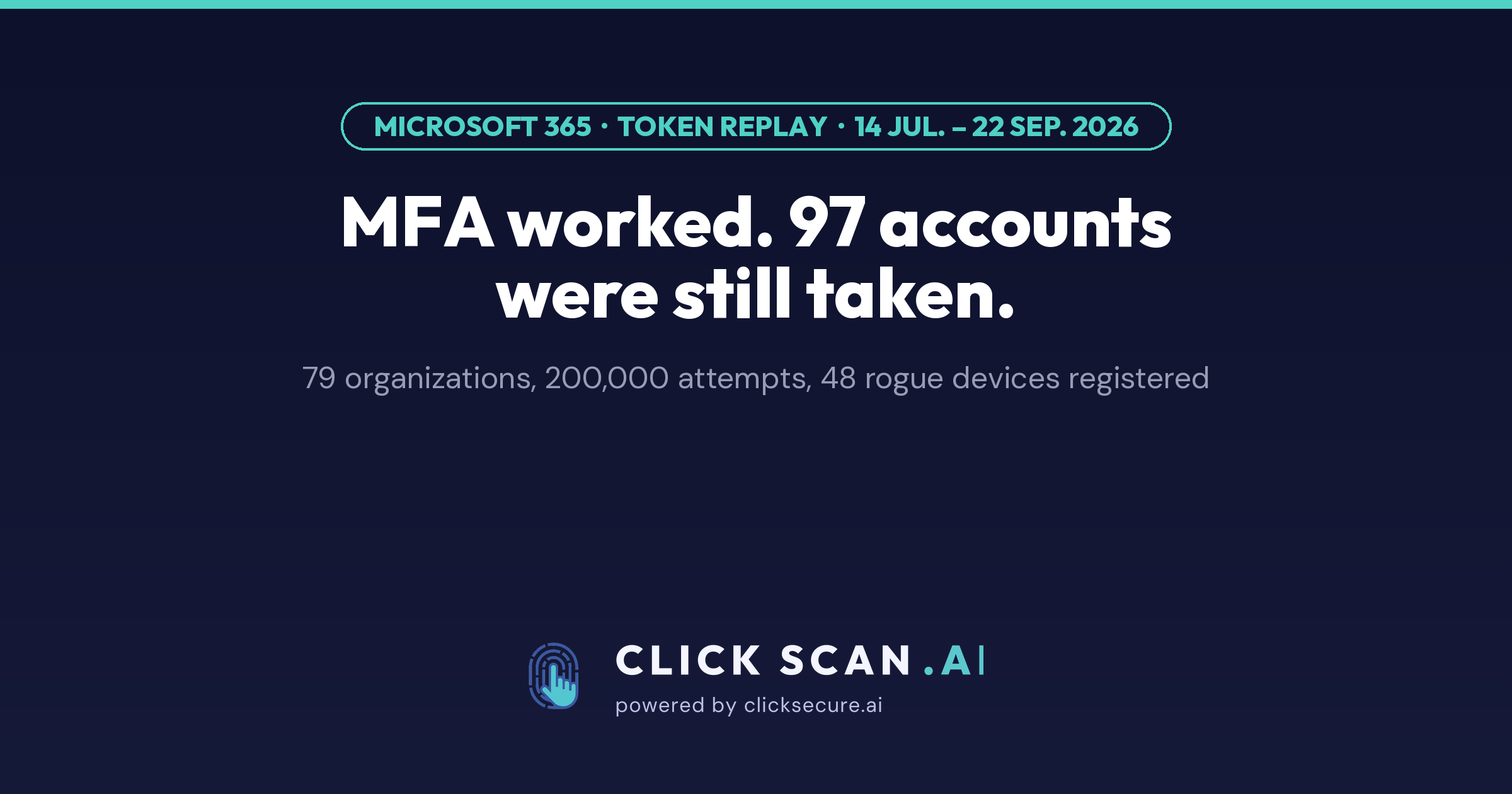
Multi-factor authentication did exactly what it was designed to do in this campaign. Every victim entered a password, every victim completed an MFA challenge, and every one of those logins succeeded on legitimate Microsoft infrastructure. Ninety-seven accounts across 79 organizations were compromised anyway.
The gap wasn't in MFA. It was in what happens in the seconds immediately after MFA succeeds.
What actually got stolen wasn't the password
The attack used an adversary-in-the-middle phishing page — a fake login screen that sits between the victim and the real Microsoft sign-in flow, quietly passing everything typed through to Microsoft's actual servers in real time. The victim's password and MFA code both travel through it. But passwords and codes aren't the valuable part anymore.
What the fake page is really after is the thing Microsoft hands back once that login succeeds: a session token, a short-lived piece of data that says "this device already proved who it is, let it in without asking again." The attacker's infrastructure captures that token the instant it's issued and replays it from its own machines, usually within minutes. From Microsoft's point of view, nothing looks wrong — the token is real, it was issued for a real, successful login, and it carries proof that MFA was already satisfied. The attacker never needs to pass an MFA challenge of their own.
Think of it less as a stolen key and more as a stolen "already checked in" wristband. The bouncer already looked at the real ID once; the wristband is what gets you back in all night without showing it again. Hand someone else your wristband and they don't need your ID at all.
The numbers, as reported by Huntress
Security firm Huntress tracked this campaign between 14 July and 22 September 2026: over 200,000 sign-in attempts, 497 of which succeeded, resulting in 97 compromised accounts spread across 79 organizations. Huntress named the technique token spraying, because the attacker replays many stolen tokens at scale across many tenants, the way password spraying works through many passwords.
Attackers registered 48 rogue devices into victim directories to keep access alive after the stolen token itself expired — a registered device can request fresh tokens on its own, and stays in the directory until somebody deletes it. They also added their own authenticator app as a second route back in. In at least 19 of the affected organizations, the victim's existing MFA methods were removed and a new one registered within three hours of the first malicious sign-in; in one case on 21 July, a new authenticator app named "iPhone 13" was active 51 minutes after the session was hijacked.
Inside compromised mailboxes, the attackers created inbox rules with deliberately unreadable names — ".", "sss", "iT", "s", "d" — to delete or bury incoming mail mentioning payroll, deposits or bonuses. One mailbox had a rule that marked everything as read and deleted it, then was used to send spam to hundreds of external recipients. The replay traffic was traced to the 193.26.115.0/24 range, associated with German hosting provider 1337 Services GmbH. Not every stolen token came from a fake login page: Huntress says some arrived through device-code phishing and through social engineering during a real login.
These figures come from Huntress's own investigation rather than from Microsoft, which has not published separate victim counts for this campaign.
Why "reset the password" doesn't fix this
The instinctive response to any account compromise is to reset the password. Here, that response does almost nothing by itself. The stolen session token isn't derived from the password — it's a separate credential that remains valid on its own schedule, independent of whatever the password is changed to. An organization that resets a compromised user's password without separately revoking that user's active sessions can watch the attacker's access continue uninterrupted through a freshly "secured" account.
The actual fix is to revoke sessions directly — forcing every active token for that account to expire — as a distinct step from a password reset, every time an account takeover is suspected.
What narrows the gap
Conditional Access is the control Huntress points to as the one that fills the gaps MFA alone cannot. It can require a sign-in to come from a known, compliant device, from an expected location, or at an acceptable risk score before a token is honored — conditions a replayed token from unfamiliar infrastructure is likely to fail even while carrying a technically valid "MFA satisfied" claim. It isn't available on every Microsoft 365 plan; it requires Entra ID P1 or P2 licensing, which is worth checking for if you don't already know whether you have it.
If Conditional Access isn't an option yet, there's still a useful, free-tier habit: periodically check the sign-in activity for your own accounts (and any admin accounts) for unfamiliar locations or device names, watch for newly registered authenticator methods you didn't add yourself, and check for mail forwarding rules or inbox rules nobody on your team created. All three are common things an attacker sets up once inside, to keep reading your mail after the session itself eventually expires.
One more thing worth knowing
Once an account is genuinely compromised this way, any phishing email the attacker sends from it will pass SPF, DKIM and DMARC without any trouble at all — because it really is leaving Microsoft's own mail servers, under your real domain, with your real signing keys. Email authentication tells a recipient that a message came from your infrastructure. It was never designed to tell them whether the person behind that infrastructure, at that moment, is actually you. If your organization relies on "it passed authentication" as a sign a message is safe, this is the exact scenario that assumption fails on — what a domain's email authentication setup can and can't tell you is worth understanding before you need it.
Sources: Huntress — Token replay and token spraying in Microsoft 365, The Hacker News — Microsoft 365 Token-Replay Attacks Compromise 97 Accounts at 79 Organizations, SecurityOnline — Token Replay Attack Hits 79 Organizations. All figures above are Huntress's own reporting; Microsoft has not published separate victim counts for this campaign at time of writing, and the operator behind the campaign has not been identified.